

This week I traveled to Orlando, Florida for the annual Gartner Symposium, one of the most influential gatherings in IT thought leadership. It brings together technology, strategy, and executive leaders from every industry to make sense of where technology is heading and how to prepare for it.
I attended the symposium a couple of times early in my career and it proved incredibly formative. Thought leaders like Ellen Kitzis and Richard Hunter shaped how I understood the CIO role, not just as a technical position, but as a steward of institutional strategy and impact. Their frameworks became part of my professional foundation, guiding my approach as I transitioned from my early leadership roles into the CIO positions at Pepperdine and now at the University of Georgia.
When I came to the University of Georgia, my priorities shifted. Between ERP implementations like Banner and PeopleSoft and the constant pull of fall semester activities, it was hard to justify being away. The Great Recession also pushed many of us to focus inward: delivering stability, not traveling constantly to conferences.
Why I Returned
After the pandemic, I made the decision to start attending again. It wasn’t about nostalgia. It was about perspective. After years in the trenches, I needed to think big again. The symposium has been useful in recalibrating that strategic lens each year.
Here’s how Gartner’s AI narrative has evolved across my three most recent symposia:
2023 - The focus was on the introduction of generative AI. Gartner drew a sharp distinction between everyday AI and game-changing AI: concepts that have become foundational to how I think about, communicate, and advocate for becoming an AI-infused University.
2024 - The tone shifted toward restraint. Gartner emphasized that not all AI is created equal, and enterprises should pace themselves. The message: don’t chase hype, especially not through enterprise-wide ChatGPT licenses or “AI for everyone” paid subscriptions that deliver little measurable impact.
2025 - The skepticism continued, but the thinking deepened. Gartner argued that AI’s biggest impacts will come from decision-making AI, not conversational AI, and that the most important work ahead is developing AI-capable people. They broke down the AI ecosystem into its essential components: talent development, vendor readiness, and sustainable impact, rather than tools and technologies.
This year’s messages validated what many of us already sense: the era of AI exuberance is fast coming to an end. What matters is patience and discipline, talent readiness, and strategic investment of what increasingly will be limited resources.
The Provocative Claim: AI and the ROI of College
The most attention-grabbing line from the keynote was blunt:
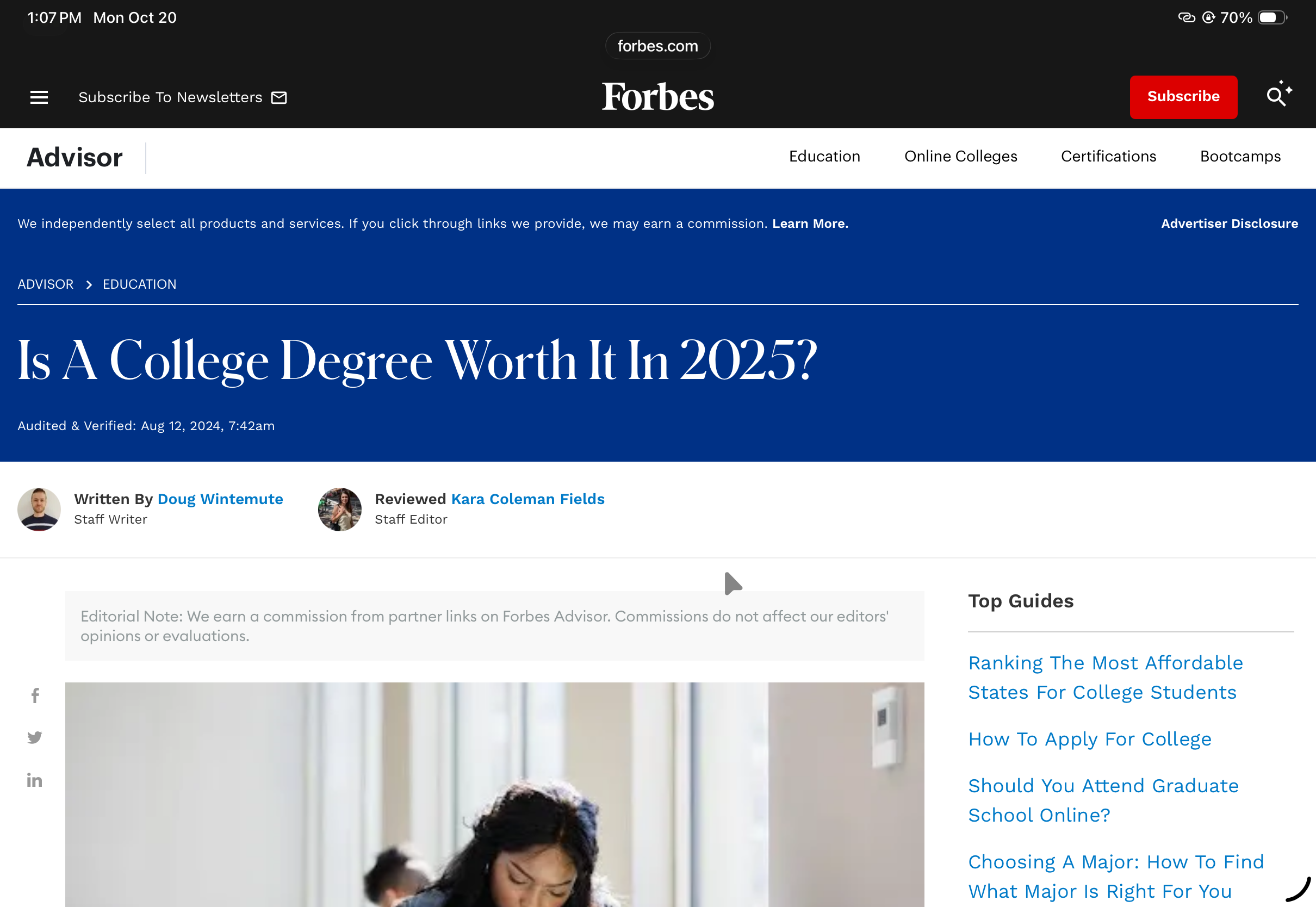
“AI will quickly erode the ROI for a college education, and by 2030 it will invert the ROI dynamic entirely.”—Daryl Plummer, Distinguished Analyst and Gartner Fellow.
Here’s how to interpret that claim:
Employer expectations are changing. Hiring will increasingly focus on non-degree indicators of AI mastery: badges, micro-credentials, and both experiential learning and service-learning experiences that demonstrate real-world application and problem-solving in community and organizational contexts.
Graduate and professional programs will feel the pressure first. Rising costs and changes to graduate loan programs, combined with tighter international student pipelines, will create existential challenges for less selective private universities.
Undergraduate ROI will depend on affordability and adaptability. State-supported institutions that combine low tuition with experiential and service-learning models will retain value. For them, stackable credentials and real-world, research-oriented critical learning can turn the AI disruption into an opportunity.
Editorial Note: The next day (10/21), Plummer backed off his initial claim regarding the ROI inversion of higher education by 2030. In a session on strategic technology trends for the next ten years, Plummer remarked that the ROI of higher education will continue to be positive to the degree that colleges infuse AI into their curriculum and student learning experiences.
Why It’s a Good Time to Be at the University of Georgia
If Gartner’s forecast is correct, the institutions most at risk are those with high cost structures and low adaptability. That’s not the University of Georgia. UGA’s long-standing commitment to affordability and access has already bent the cost curve downward for Georgia families. Our approach has been student-centered: holding tuition flat while continuing to invest in the quality of the learning experience. That balance between fiscal restraint and academic ambition is what gives public institutions like ours an edge in the next phase of higher education’s transformation.
UGA’s students also benefit from a culture that blends learning, service, and research into a single, integrated experience. From service-learning projects that strengthen communities to undergraduate research programs that solve real problems, these experiences build the very kind of adaptive intelligence Gartner says the AI economy will reward. Through the Common Learner Record, students can capture and showcase these moments, course by course and project by project, demonstrating how a UGA education develops both professional capability and AI literacy.
The final word
AI may transform higher education economics, but not evenly. For institutions like the University of Georgia, it’s an accelerant, not a threat. The value of what we offer, affordable and rigorous learning that produces adaptable graduates, is rising, not falling. Leaving Gartner Symposium 2025, that message stood out clearly.
It is an honor to serve UGA at such a pivotal moment in its history. Our mission, our students, and our state all stand to benefit from the AI-infused transformation ahead.