

I’ve met a lot of ambitious IT professionals who struggle with how to make the jump from managing a single domain like networking or applications to stepping into the CIO role. Some aim high early, climbing to a senior position at a major institution. Others, like me, take a different road: starting small, owning more, and learning fast.
My first CIO title came while serving a small branch campus of Texas A&M. Fewer than 100 students. A handful of staff. It was modest, but it was mine. I had a seat at the table, even if the table was small. What mattered most was that I worked for leaders who believed in investing in potential. They sent me to the Gartner CIO Academy, where I first met Ellen Kitzis, a fellow sociologist and a thinker who saw technology leadership not just as systems and strategy, but as a human endeavor.
Her book, The New CIO Leader, co-written with Marianne Broadbent, laid out a vision for a new kind of IT leadership in the wake of the dot-com collapse. It became my field guide. In today’s Dispatch, I want to revisit its central premise: CIO trust and credibility is everything. And that credibility lives or dies not based on our technical prowess but in how we negotiate the daily gap between expectations and resources.
The big picture
The dot-com crash made one thing clear: IT leaders couldn’t just be builders anymore. In the late 1990s, the mandate was speed: launch systems, ride the hype, and move fast enough to stay ahead of the curve. But when capital dried up and hollow business models collapsed, it became obvious that unchecked growth wasn’t innovation, it was risk. The era demanded a new kind of IT leadership, one grounded in strategic alignment, fiscal discipline, and measurable value. From that point forward, IT leaders had to evolve: from system builders to enterprise stewards, from technologists to partners in driving real business outcomes. The need for change was apparent.
Against that backdrop, The New CIO Leader by Marianne Broadbent and Ellen Kitzis (2004) offered a blueprint for how IT leaders could rebuild: not just systems, but their leadership identity. They argued that the era of the “chief technology mechanic” was over. IT leaders needed to grow into leaders capable of bridging strategy and execution, business and technology. Their redefinition of the role remains relevant today: from articulating a vision to driving measurable outcomes, from shaping expectations to building resilient, high-performing teams. The message was clear and urgent: survival and success in an economy of scarcity would depend on IT leaders who think strategically, govern wisely, and lead with influence across the enterprise.
A Field Guide for Emerging CIO Leaders
For me, The New CIO Leader was a field guide as I stepped into my first CIO role at a small overseas branch campus. While the infrastructure was minimal, the stakes were personal, and the work was foundational. Over time, I found that while we were doing a lot of building, the real lesson was in execution. Delivering on what we promised and doing it consistently was how we earned trust, kept momentum, and gained respect. Leadership was about proving, day after day, that we could follow through.
The most important part of the book starts on page 20.
The CIO who is literally new in his or her position is given initial credibility. Based on that credibility, the new CIO receives resources and permission to undertake various IT initiatives. Those initiatives have outcomes and results, which, depending on what they are and whether they benefit the enterprise, in the eyes of the enterprise leaders, either enhance or diminish the CIO’s credibility. The whole process becomes either a virtuous cycle or a downward spiral. Every success, again, in the eyes of the leaders, builds more credibility. Every failure or nonsuccess chips away at the CIO’s credibility.
The “Credibility Cycle” has been the core of my case for why negotiation is an essential leadership skill for IT leaders, especially in my EDUCAUSE seminars.
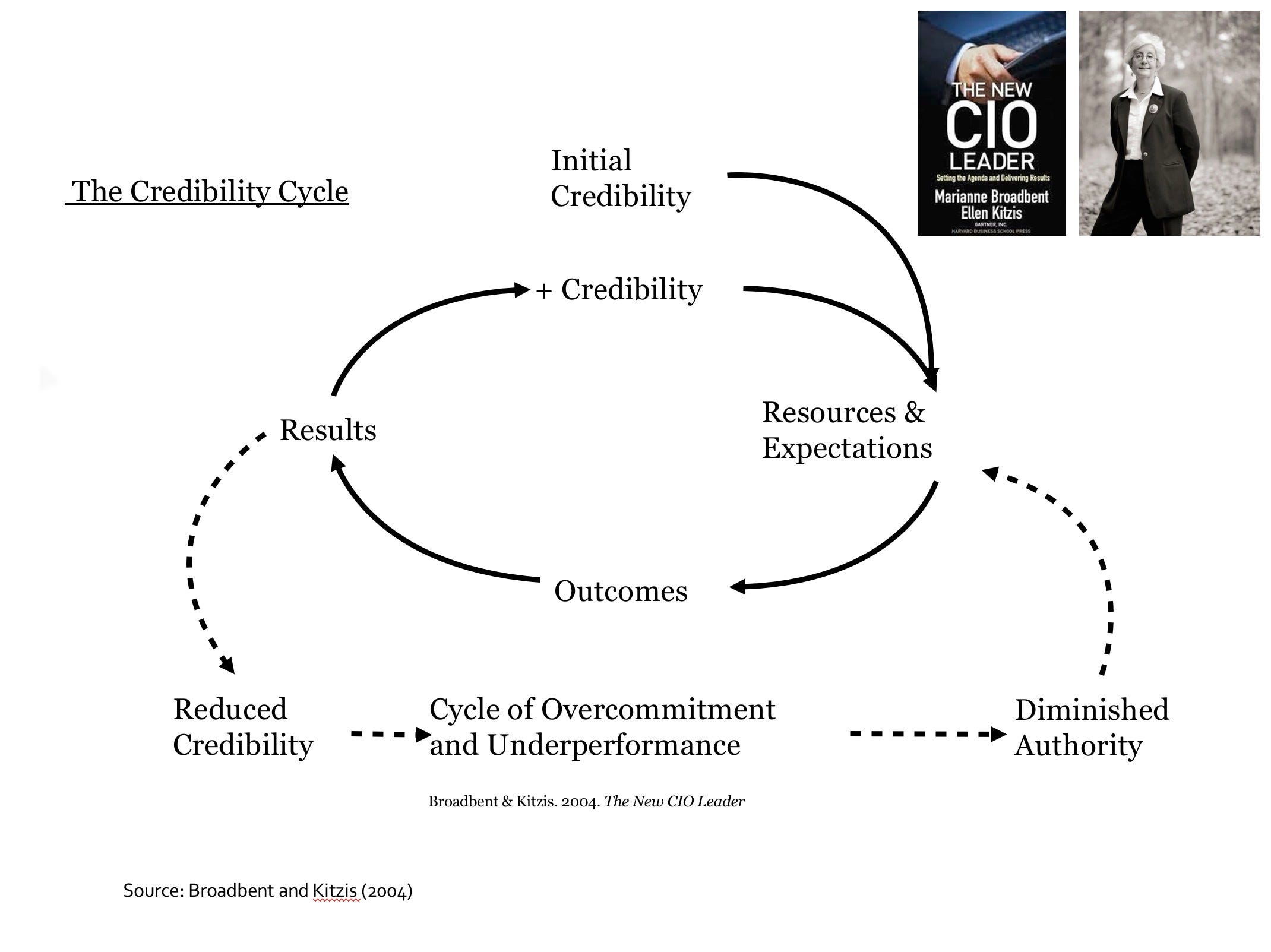
The relationship between credibility, expectations, resources, and outcomes is everything. If you overpromise and underdeliver, trust erodes. If you commit without resources, your set your team up to fail. Credibility isn’t just earned by effort, it’s built by aligning what’s expected with what’s possible, and then delivering with discipline.
Negotiation skills are not just tactics, but the skill that keeps the credibility cycle alive.
Chester Karrass teaches that negotiation is the process by which you manage power and credibility over time, showing that every concession or demand either strengthens or weakens how others perceive your reliability.
Chris Voss emphasizes that credibility in negotiation comes from tactical empathy and consistency, where demonstrating understanding and calm control builds trust faster than authority or logic alone.
Bob Iger’s advice that relationships are best managed by continually making small deposits, keeping give and take balanced, also helps to maintain trust and credibility.
I’ve transitioned into two CIO roles, at Pepperdine (2007) and at the University of Georgia (2011). Both times, I used that initial burst of credibility to do some things long overdue. I was fortunate enough that those bets, some of them pretty bold, paid off and reinforced growing credibility, trust, and respect with deans and executives.
At Pepperdine, I redirected major investments away from poorly conceived infrastructure projects, removed ineffective leaders, restructured the PeopleSoft implementation team to prioritize empathy and communication over experience, and elevated a previously overlooked budget manager into a key leadership role. He became my deputy and eventual successor, and is still thriving in that position.
At the University of Georgia, I redirected significant numbers of key personnel to reprogram legacy systems, eliminate social security numbers as primary identifiers, and mandate encryption for all PII in transit and at rest. This effort became the top priority for all IT employees for over 18 months, cutting deep into technical debt and laying the groundwork for long-term information security.
Credibility isn’t a one-time asset; it’s something you earn early and sustain through consistent, transparent communication. To maintain that trust, I’ve relied on rhythm and visibility: monthly status reports to track progress, annual planning memoranda to align priorities, and regular “State of IT” updates that turn feedback into action. These practices aren’t just about reporting, they’re about reinforcing trust, surfacing friction before it becomes failure, and proving, again and again, that IT can be trusted.
Within higher education, deans can become your strongest advocates or your fiercest detractors. Engage them early, often, and treat them as co-equals with the institution’s senior executives. Their support, or resistance, can make or break your most critical initiatives. For CIOs in higher ed, this isn’t just diplomacy; it’s strategy.
The final word
At its core, negotiation is about more than getting to yes. For IT leaders, it’s how you balance power and partnership, credibility and constraint. In higher education, where credibility must be earned daily and trust can vanish overnight, negotiation is the quiet discipline that keeps relationships intact, priorities aligned, and momentum alive. It’s not a skill for the margins of leadership. It’s central to sustaining it.
That’s the difference between CIOs who align expectations with resources and those who earn a reputation as the “no police.” One builds trust. The other builds walls.
Spot on